Monastery of Panagia (the Virgin Mary) in Karydi
The small monastery is located between the villages of Vamos and Vryses, near the village of Karydi Kartsomatado (Caridi Charcomita or Charcomatadho), where there was once an older village mentioned in the sources.
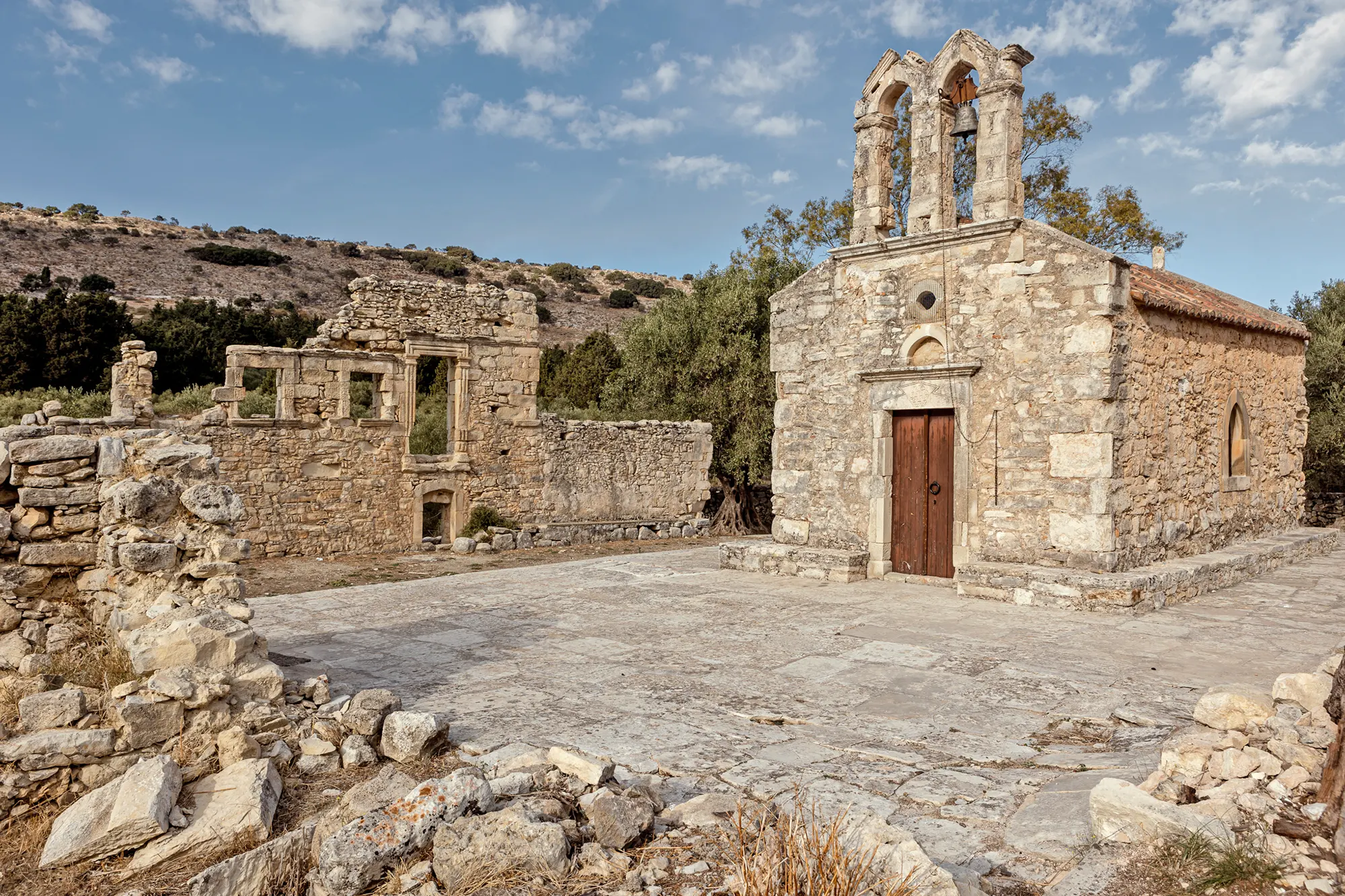
The simple, single-nave, barrel-vaulted church of the late 13th century is all that survives in good condition of the monastery complex. The ruins of the monastery buildings can be seen all around.
In the sanctuary of the church is a dedicatory inscription of the year 1290, when the church was built and painted with frescoes. The inscription mentions Leon Avramis as the donor. The surviving fresco decoration includes interesting depictions of the damned.
In a later period, the church was the catholicon of a small monastery, of which the ruins of the southwest wing are visible. The architectural evidence reveals that a two-storey building, probably the abbot’s quarters, was constructed on the north side at the end of the Venetian period.
The fresco decoration of the church survives in a moderate and in places fragmentary condition. It belongs to a single layer, although three different artists probably collaborated to paint different parts of the church.
The artists follow the stylistic trends popular on the island during the early Venetian period, when the models of the Late Komnenian period were reproduced. The iconographic programme is typical of single-nave churches of the period, with the Virgin Platytera (Wider than the Heavens) in the conch of the apse, frontal hierarchs on the semi-circular wall of the apse, the Ascension in the vault, scenes from the Gospel cycle in the upper zone and full-length saints in the lower zone. The iconography is interesting, as the artists depict the political and social conditions of their time. The depiction of the damned of the Second Coming and that of St George Slaying the Dragon, with the saint carrying a shield bearing an eagle emblem and killing a soldier in western dress, bear witness to the background situation during this period.
-
- Church of the Panagia, Karydi. The church and the ruins of the monastery. View from the SW (source: Sotiris Zapantiotis).
-
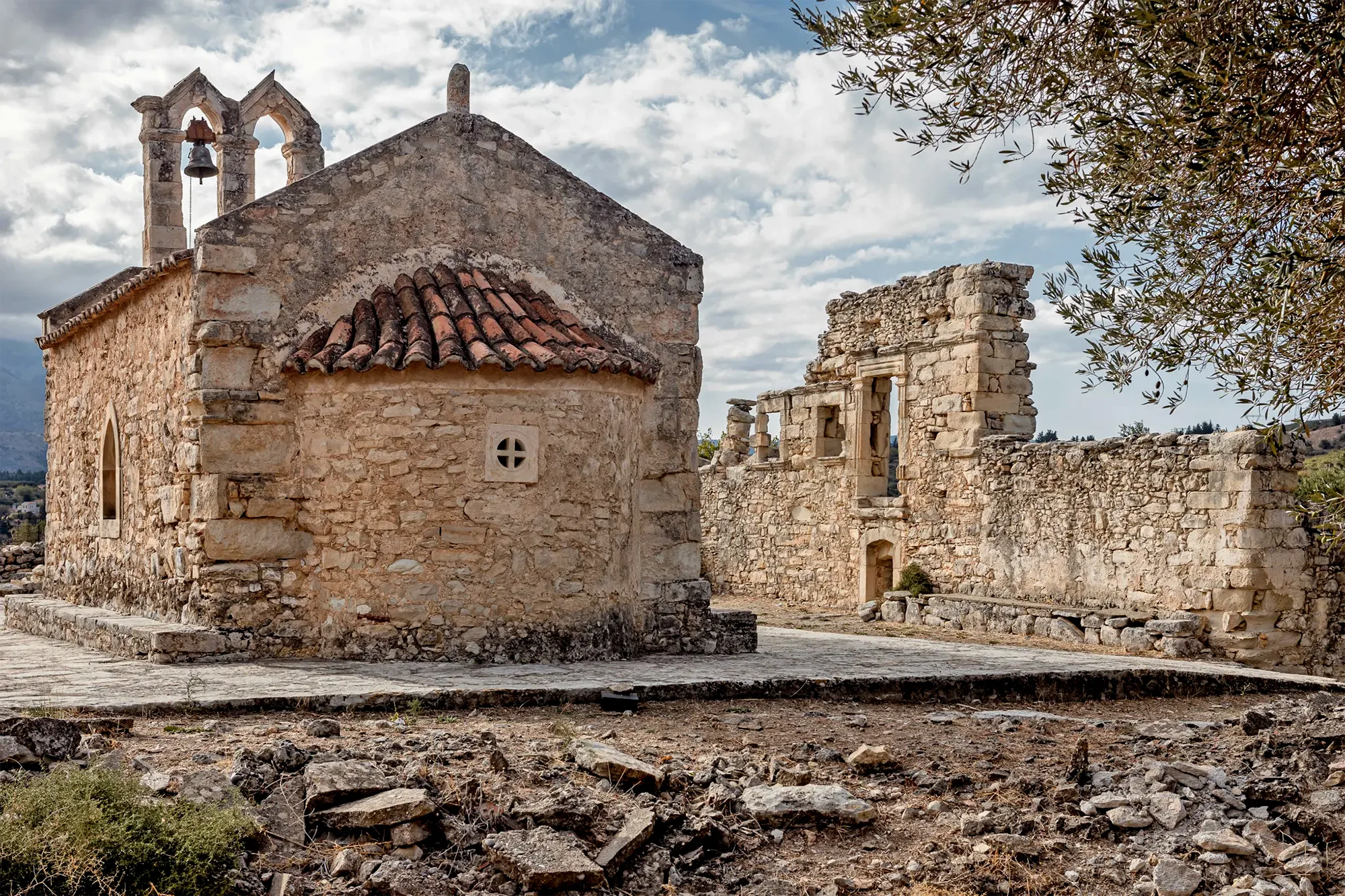
- Church of the Panagia, Karydi. The church and the ruins of the monastery. View from the SE (source: Sotiris Zapantiotis).
-
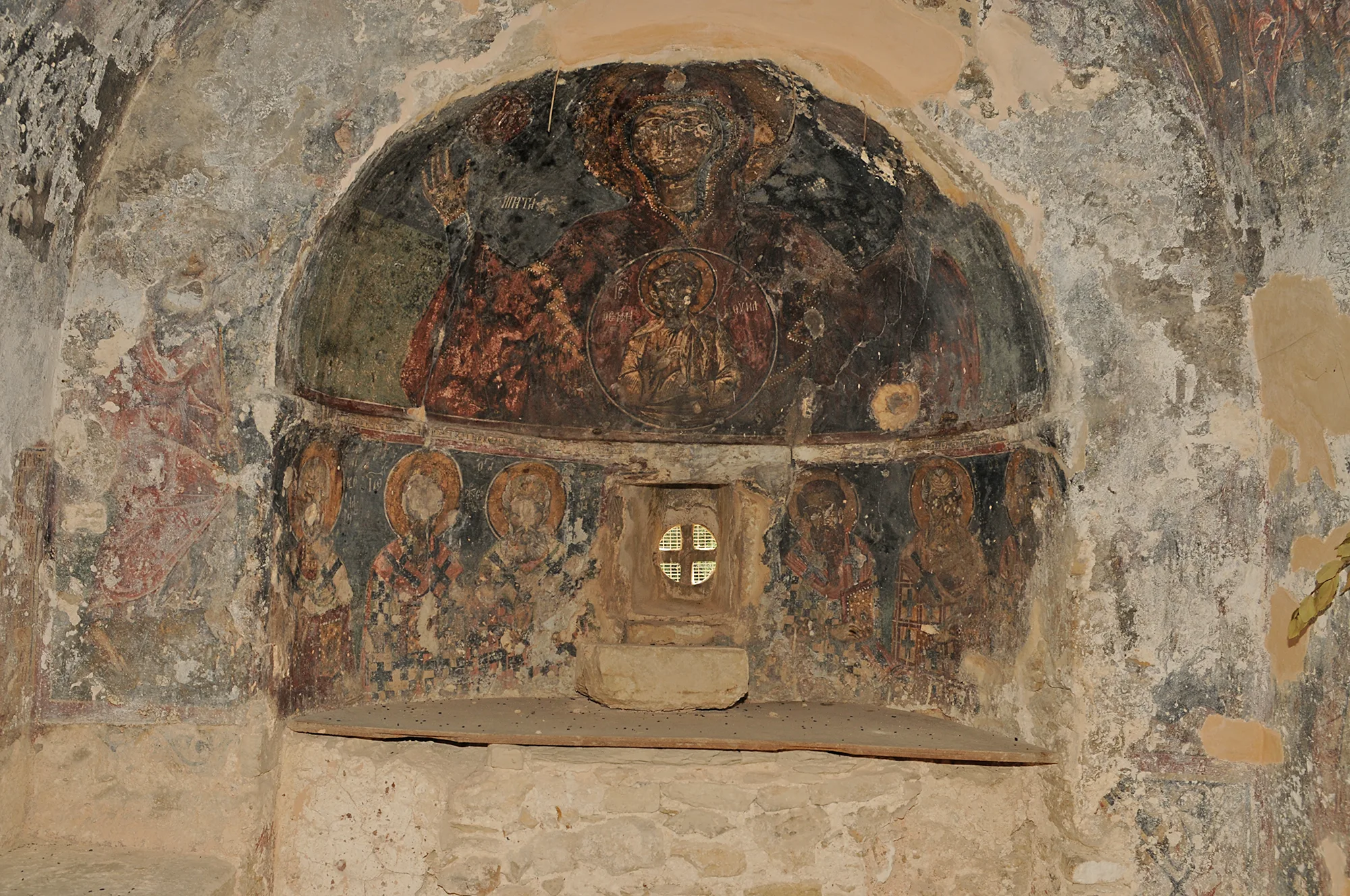
- Church of the Panagia, Karydi. Remains of frescoes in the apse (source: Ministry of Culture, Ephorate of Antiquities of Chania).
 Monastery of Panagia in Karydi in the Route of Timelessness
 Monastery of Panagia in Karydi in the Route of Rural Life
The inclusion of the depiction of the damned in the iconographic programme of the church hints at the handling of “damnable” criminal activities within the Orthodox community, possibly through the guidance of the acephalous Church of Crete, bypassing the official Venetian legal system.
-
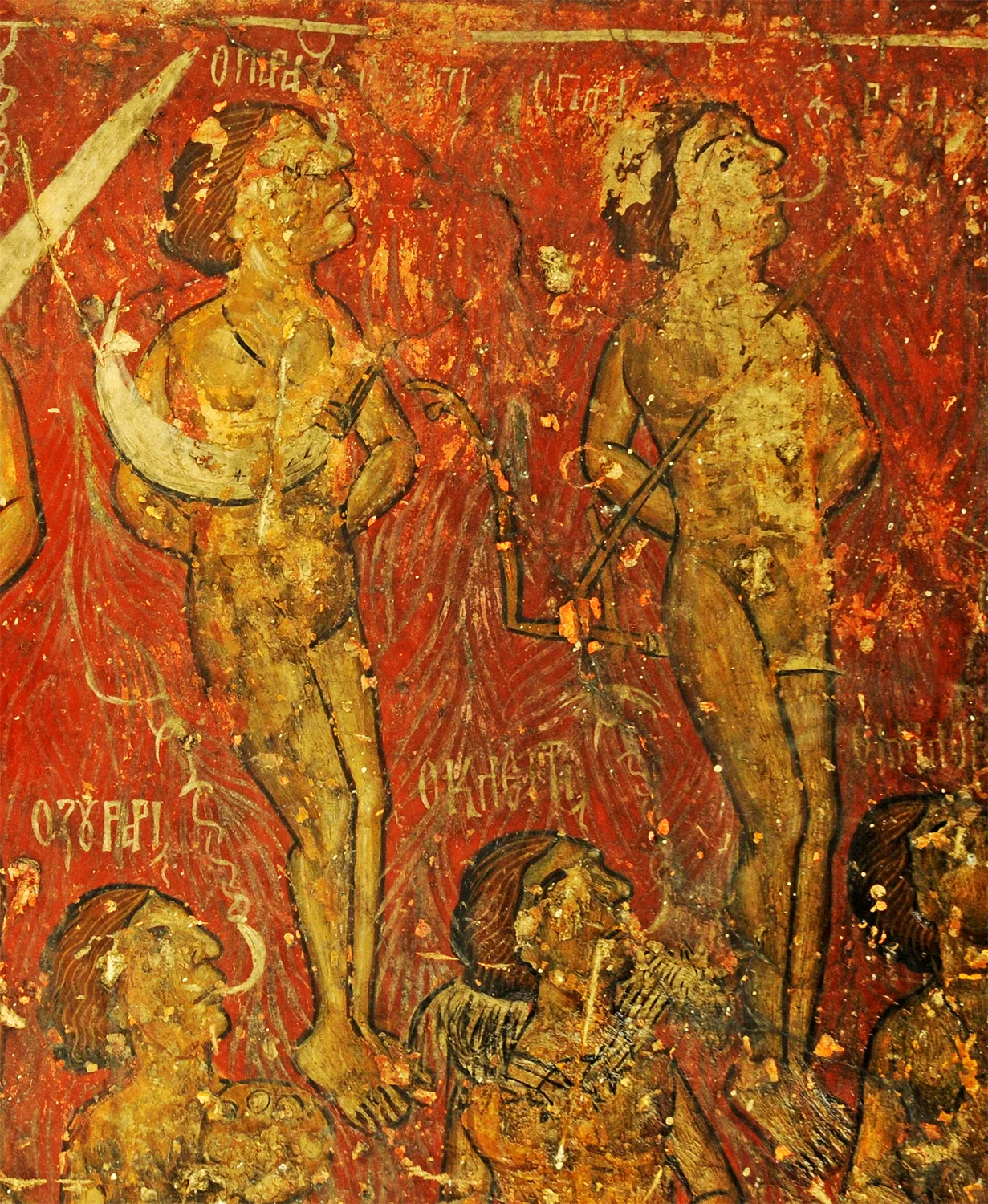
- Panagia, Karydi. He who reaps and he who ploughs over the boundary line. The former has a sickle hanging on his chest, while the latter is impaled on a plough, as is commonly the case in Cretan depictions of the subject (source: Ministry of Culture, Ephorate of Antiquities of Chania).
-
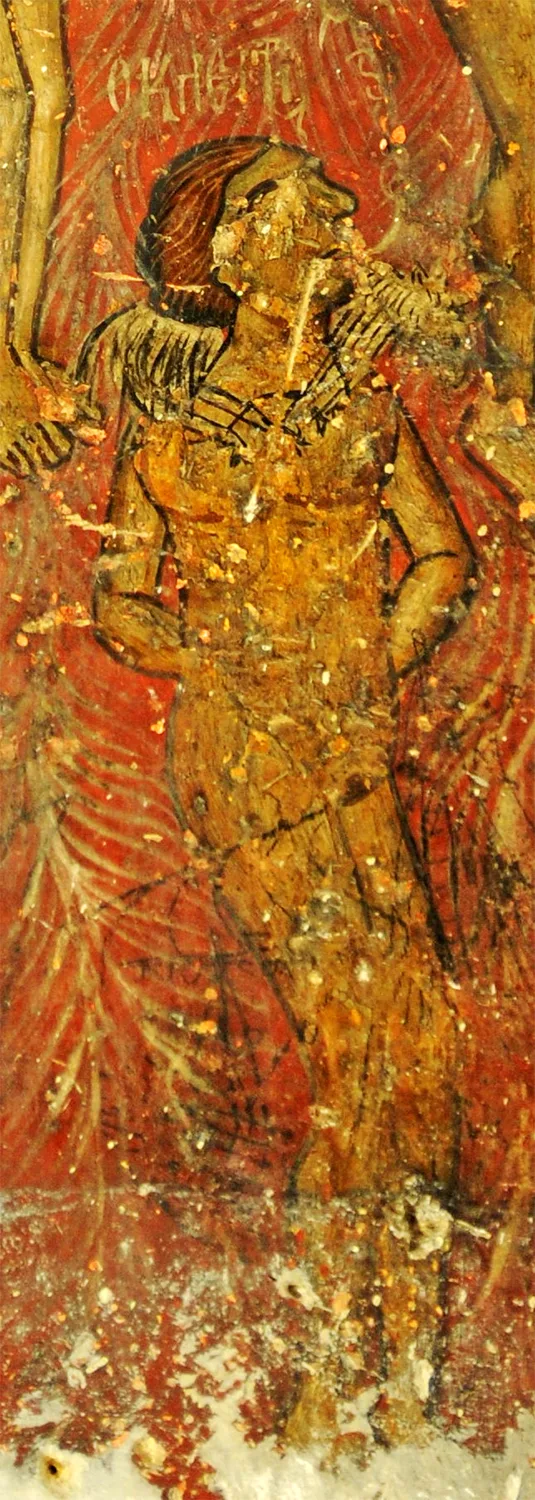
- Panagia, Karydi. The sheep-stealer. The figure is naked and has his hands bound behind his back. On his shoulders are the stolen goods: a goat (source: Ministry of Culture, Ephorate of Antiquities of Chania).
 Monastery of Panagia in Karydi in the Route of Life and Death
The verdict of the scales sent believers to Heaven or Hell, defining the framework of a good Christian life.
-
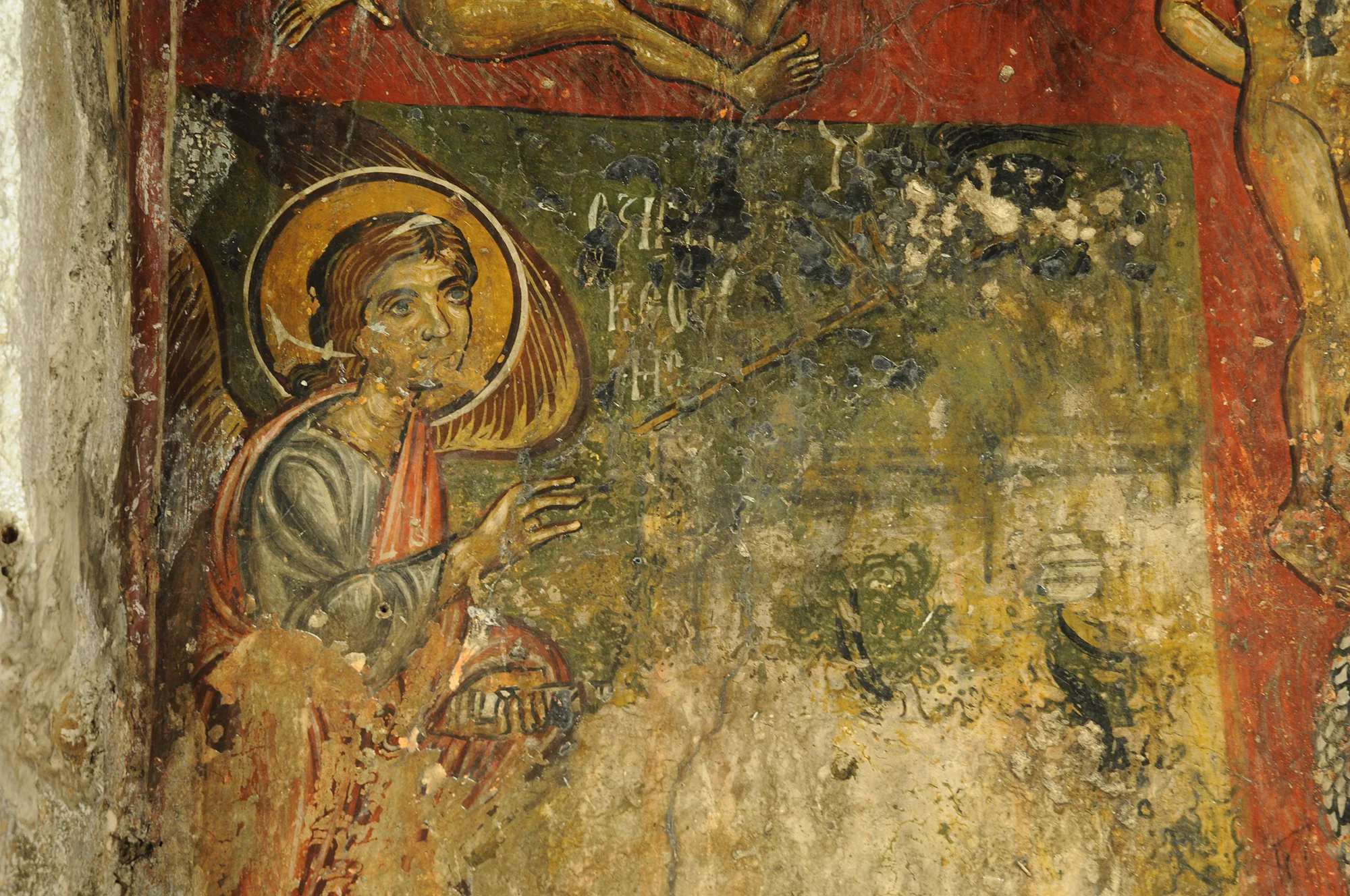
- Panagia, Karydi. The Angel of the Weighing of Souls (Psychostasia) with the scales in which the souls are weighed (source: Ministry of Culture, Ephorate of Antiquities of Chania).
 Monastery of Panagia in Karydi in the Route of Byzantine Art
The female sinners are depicted in a separate panel from the male sinners, reflecting the distinction between the sexes during this period and the different activities that could lead each to hell. All the figures are depicted on a red background as they are consumed by the fiery tongues of hell. Sinful women are usually condemned to hell for sexual “crimes”, such as prostitution and procurement, but also for behaviours attributable to their female nature. The medieval concept of the natural connection between women and sin is displayed in the depiction of a serpent threatening the organ of sin in each case (the mouth of the meddler, the breast of the mother who refuses to suckle her infant). The serpent symbolises woman’s unbroken connection with original sin. The image of the serpent as an allegory of female nature in this church is distinguished by the fact that the sins associated with fraud in women’s work and with fraud and crimes committed by the male sex do not include a serpent. The instrument with which the crime or fraud was committed is depicted instead. Thus the murderer is accompanied by a knife and the cheating weaver by loomweights. However, what resulted in torture by serpent for both sexes was sexual activity. A serpent sinks its fangs into the genitals of the lecher, perhaps the victim of the procuress, who is depicted with a snake biting her mouth, the organ of her sinful profession. A pimp is not portrayed in the hell of men.
The connection between guilt and original sin is also reflected in the nakedness of the figures, which they are no longer able to hide.
Besides the gender perceptions reflected in the images, elements relating to work and rural life can also be seen.
-
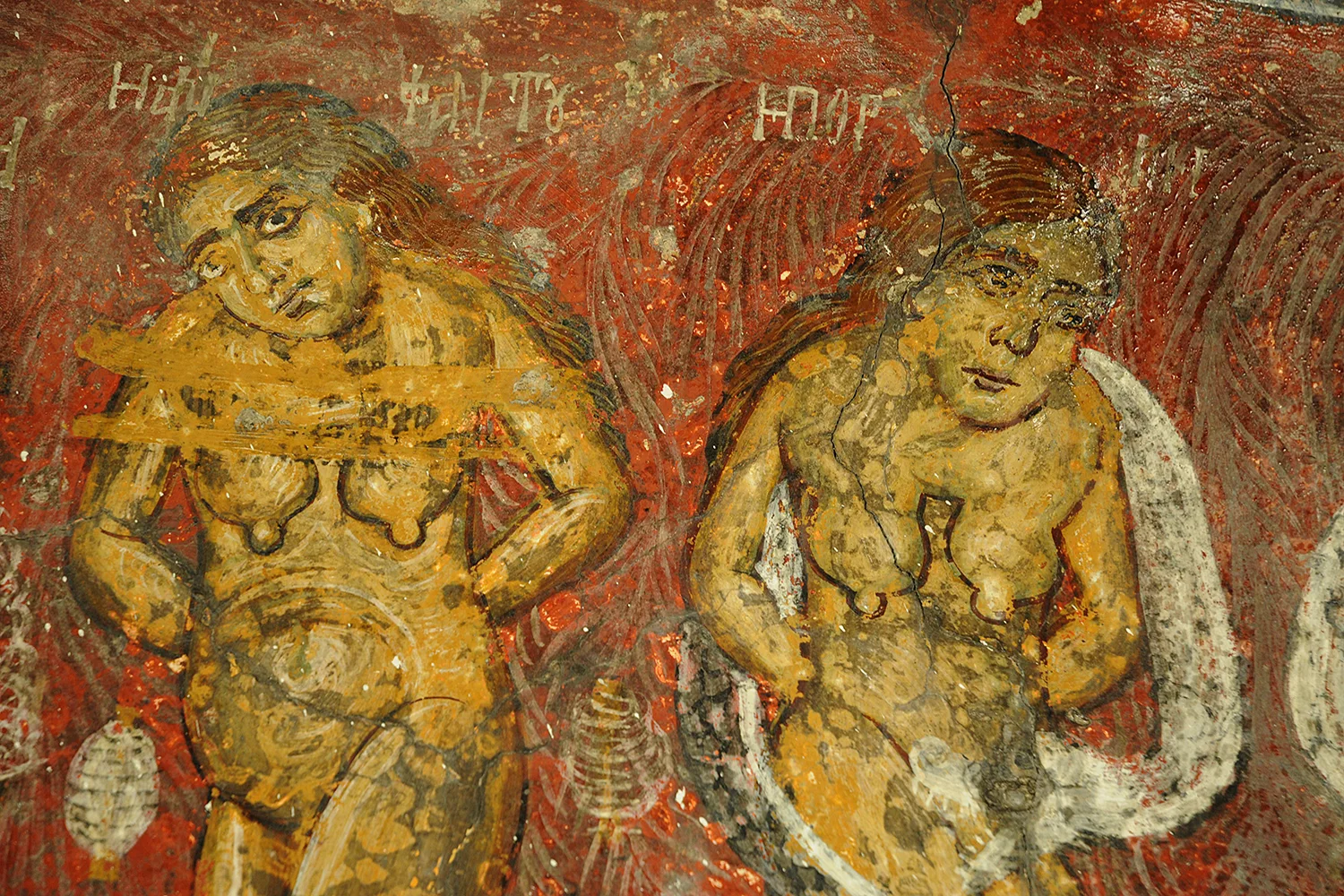
- Panagia in Karydi. Detail of damned women (source: Ministry of Culture, Ephorate of Antiquities of Chania).
-
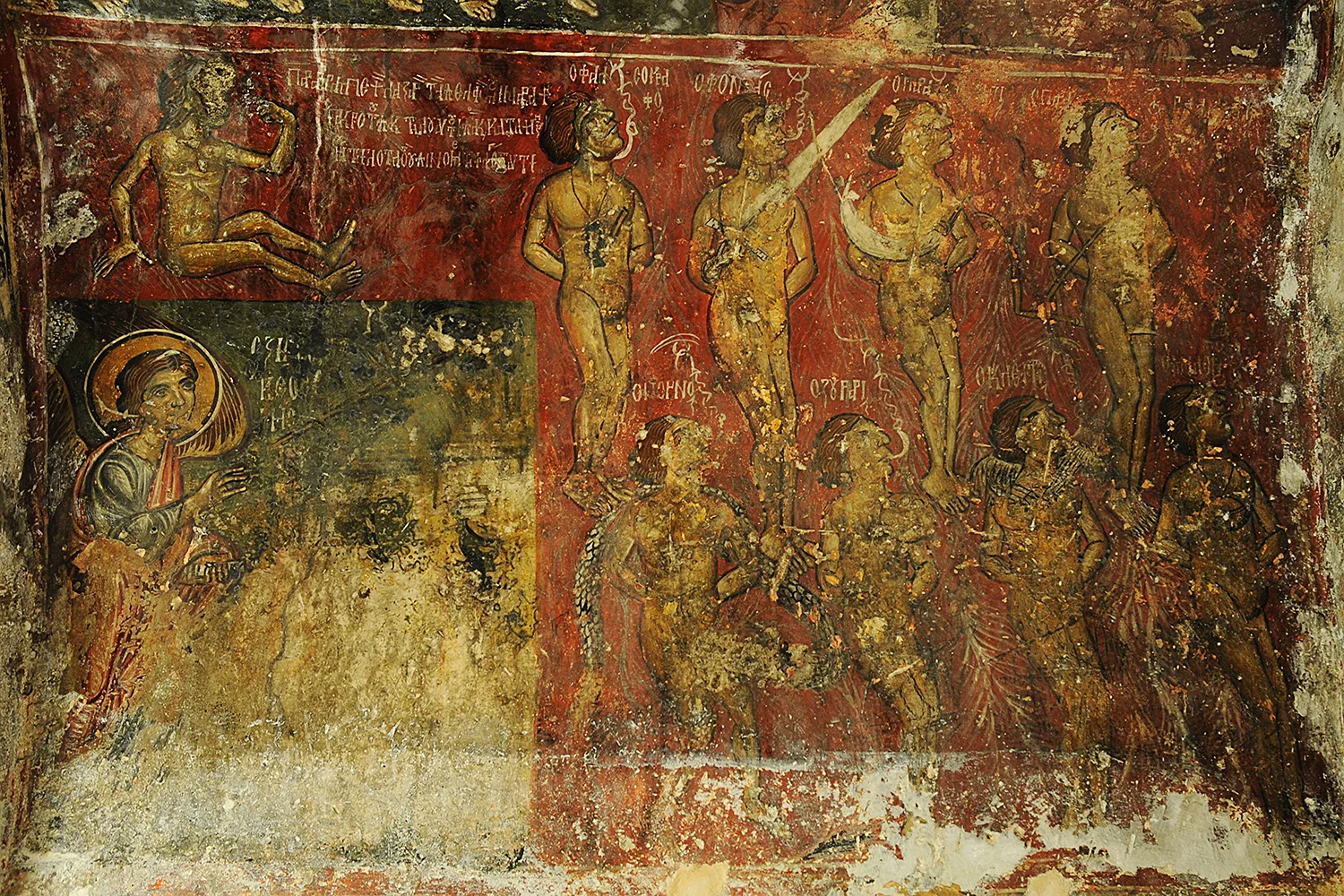
- Panagia in Karydi. Detail of damned men (source: Ministry of Culture, Ephorate of Antiquities of Chania).
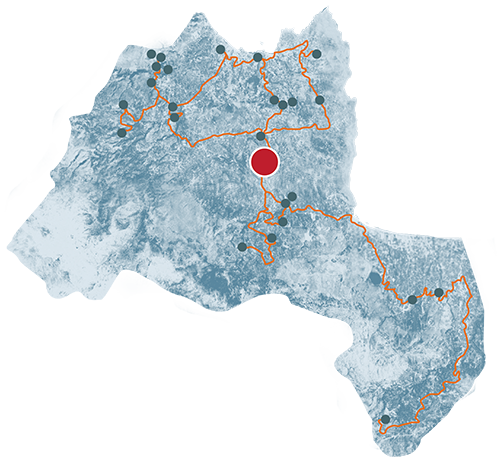
Karydi
The monastery is located between the villages of Vamos and Vryses Apokoronas at the place where the Venetian settlement of Karidi Agios Georgios was built, 2 km east of Vamos, at an altitude of about 190m.