Late Minoan megaron at Samonas
Excavations have brought to light the remains of a megaron-type building at the Kylindra site, just outside the village of Samonas. Building I is a four-sided, free-standing house surrounded what is probably a defensive perimeter wall. It consists of 12 rooms in a row on the vertical axis, a common practice in Mycenaean architecture. Stone tools discovered in various rooms indicate that the residents engaged in handicrafts and other industrial activities. One of the rooms served as a domestic shrine. The life of the settlement ended during Late Minoan IIIB (1300-1200 BC), when settlements and cemeteries were destroyed and abandoned.
The Mycenaean architectural remains found on the island date from the Final Palatial and Postpalatial periods (1450-1100 BC) and follow the typology of the sites in mainland Greece. Megaron-like structures are common from 1200 BC onwards, usually consisting of one, two or more rarely three rooms.
During the Final Palatial period (1450-1380 BC), the only palace in Crete with a sizeable territory was that of Knossos. The king of Knossos was Mycenaean, as were the warrior aristocrats surrounding him. During this period the administrative language was Greek, as the Linear B tablets attest. Circa 1380 BC (late LM III A1/ early LM III A2), the earliest traces of Mycenaean presence are attested in West Crete, where Mycenaean influences are more pronounced than on the rest of the island.
In the following period, independent states come to the fore, such as that of Kydonia on the Kastelli Hill in what is now the city of Chania.
Mycenaean–Minoan relations are reflected in the tradition that the mother of King Agamemnon was a Cretan princess.
-
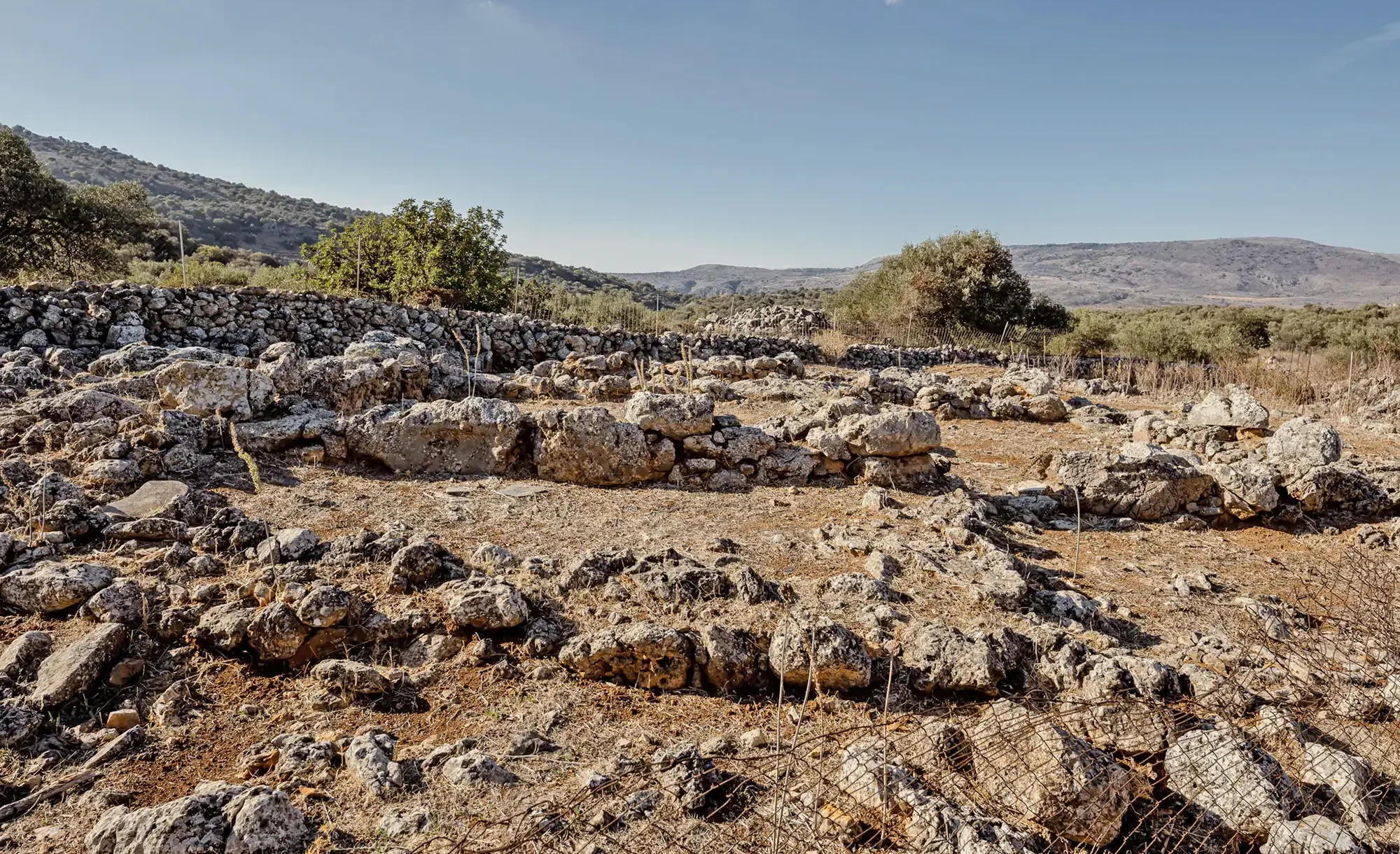
- Late Minoan megaron, Samonas. Remains of walls at the archaeological site (source: Sotiris Zapantiotis).
-
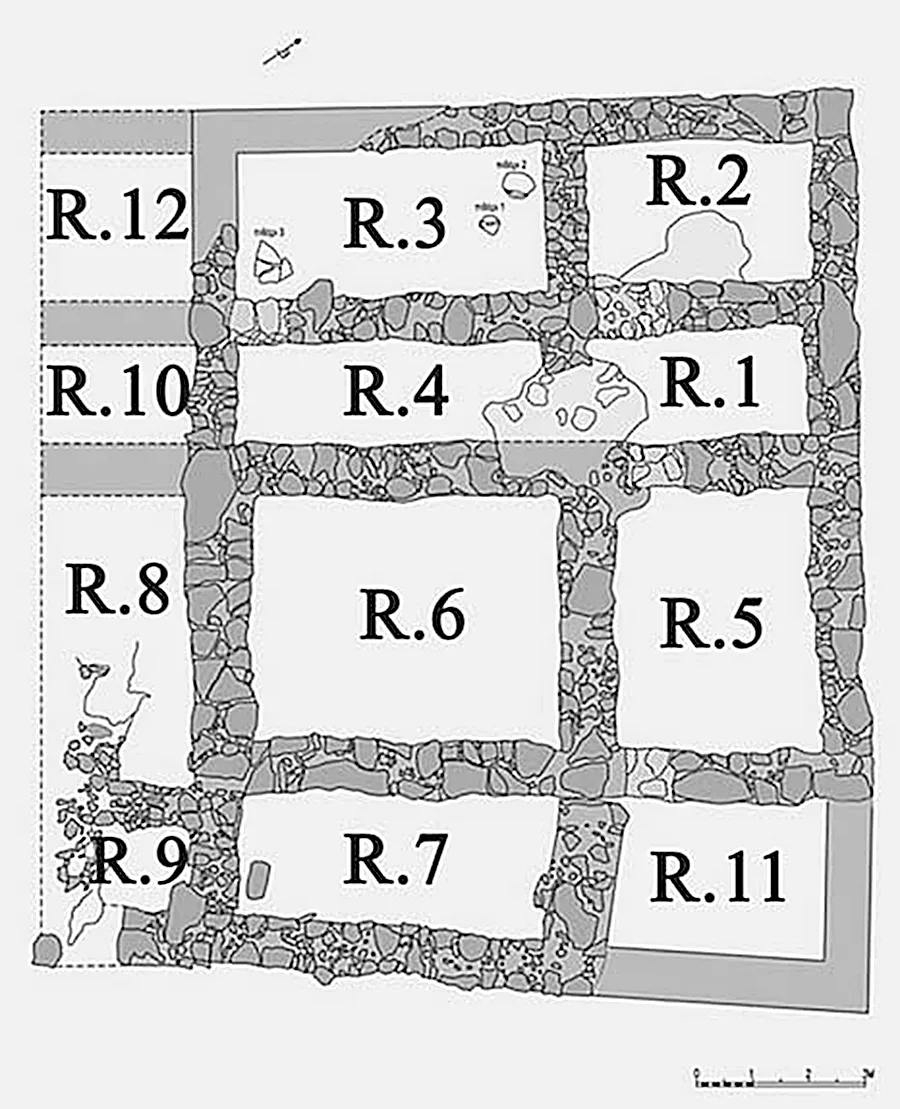
- Late Minoan megaron, Samonas. Plan of Building I (source: Athanasia Kanta, “Η πεδιάδα του Στύλου, τα μυκηναϊκού τύπου κτήρια του Σαμωνά Αποκορώνου και οι ιστορικές εξελίξεις του 13ου και 12ου αιώνα π.Χ.”, Β΄ Παγκόσμιο Συνέδριο Αποκορωνιωτών, «Αποκόρωνας: Παρελθόν και Προοπτική», Άγιοι Πάντες Αποκορώνου, 31 Αυγούστου-4 Σεπτεμβρίου 2017, Πρακτικά, vol. A, Chania 2020, 77-91).
 Late Minoan megaron at Samonas in the Route of Timelessness
 Late Minoan megaron at Samonas in the Route of Rural Life
A distinctive feature of both this area and that of Stylos is the residential pattern in which there was no coherent settlement nucleus, as in most parts of Crete, but habitation was kata komas, in groups of several villages or in neighbourhoods of extended families or kin groups. This particular settlement pattern has been preserved in West Crete to this day. The settlement, the tomb and the kiln revealed by the archaeological excavations in the area show why the plain of Stylos was chosen for habitation in such an early period. The abundant springs rising in the White Mountains, the smooth terrain and the area’s proximity to Suda Bay, which contains accessible, naturally fortified anchorages, are the main reasons why people chose to settle here.
Samonas
The traditional settlement of Samonas is an entirely restored neighborhood located in the village of the same name in the province of Apokoronas in Crete, at an altitude of 400 m and 25 km from Chania.