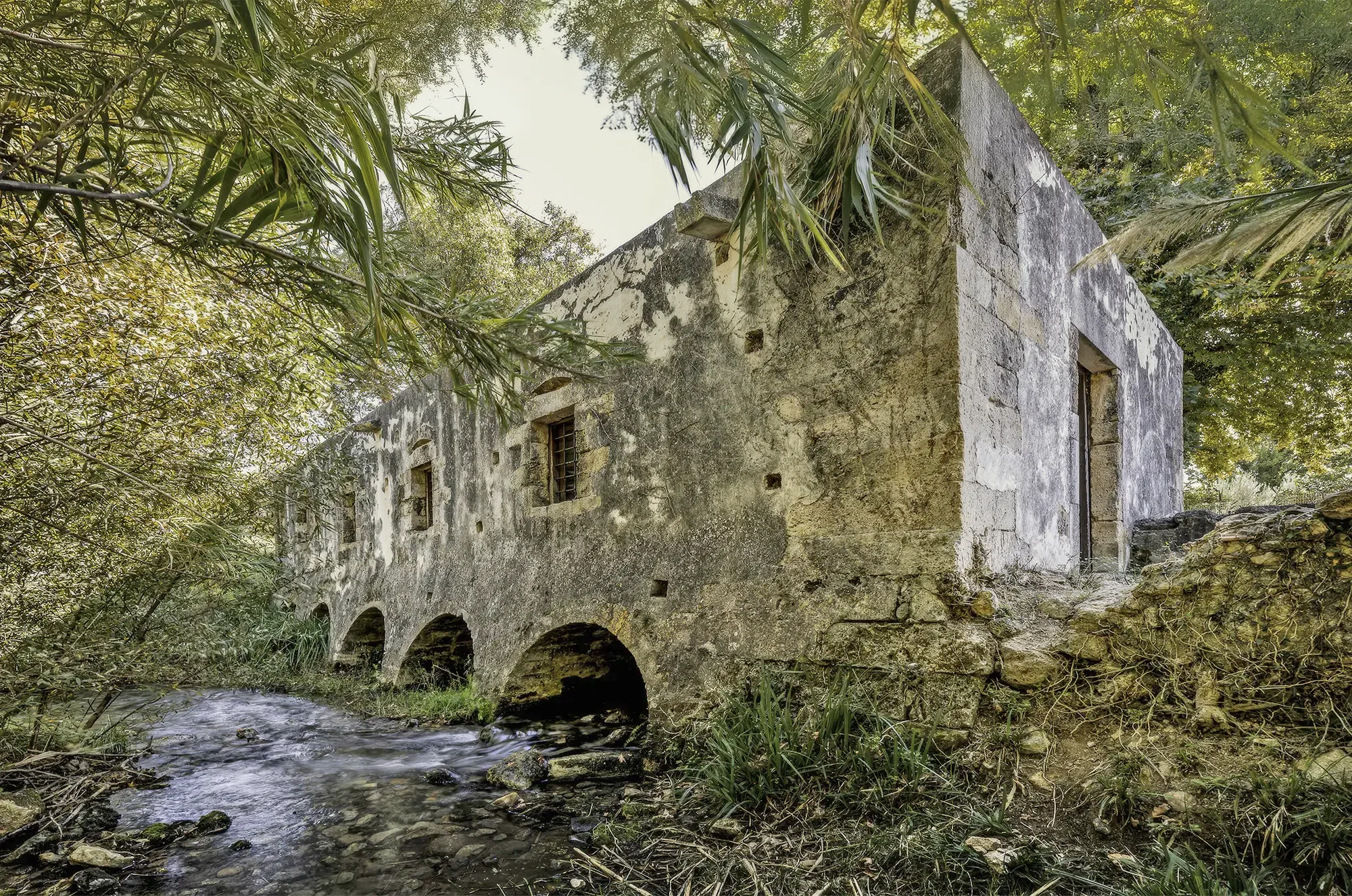
Watermill of Kalogeroi in Stylos
The watermill of Kalogeroi (meaning “of the monks”) is located near the village of Stylos. This is one of the largest watermills in Crete, with five water outlets. It operated with five water wheels and five pairs of millstones. It was supplied with water from the River Koiliaris via a trapezoidal stone water cistern 5 m south of the mill. The water was channelled through a wide wooden flume (vayeni) into a hole in the base of the south face of the mill (zourio), where the waterwheel is located. The mill had horizontal waterwheels (known as the Greek or oriental type).
Watermills like that of Stylos were mainly used for grinding grain. In the Apokoronas region, watermills were also built in the 15th century for sugar processing.
On the main face of the mill are the water outlets with the corresponding openings providing natural light and ventilation. The mill of Stylos is a three-room mill, as the original one-room building was modified and added to. The first room was used for workshops and access, the second housed the pairs of millstones, and the third was the storeroom. This last room often served as a rest area for the workers. It had a fireplace due to the humidity, and it was also used for preparing food.
To the west of the watermill, a one-room olive mill was built at a later date. Initially the two units operated in tandem, but with the advance of technology the watermill ceased to operate and became the storeroom of the olive mill.
The watermill “of the monks” belonged to the dependency of the Monastery of St John the Divine of Patmos and was part of the system of watermills built by the monastery during the Venetian period to process the agricultural products of the dependency. According to the local inhabitants, the watermill was ceded by the monastery to the community, whose property it remained in the modern era. It was in use until 1960.
-
- Watermill of Kalogeroi, Stylos. The placement of the watermill relative to the river can be seen (source: Sotiris Zapantiotis).
-
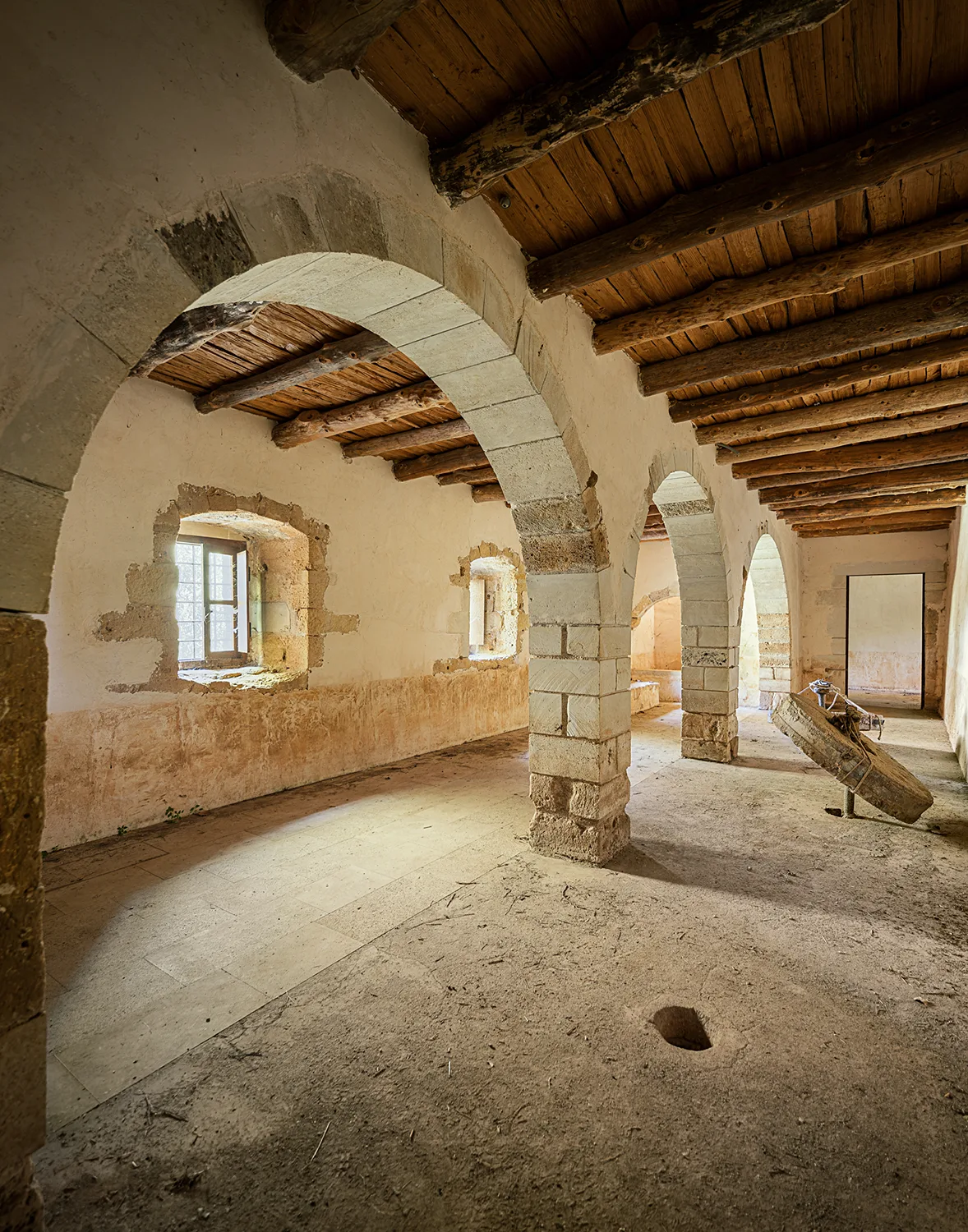
- Watermill of Kalogeroi, Stylos. The interior of the watermill with a millstone (source: Sotiris Zapantiotis).
 Watermill of Kalogeroi in Stylos in the Route of Timelessness
 Watermill of Kalogeroi, Stylos in the Route of Water
The name of the watermill (kalogeroi means “monks”) is due to the fact that it belonged to the Monastery of St John the Divine of Patmos, making it a typical example of a monastic watermill.
-
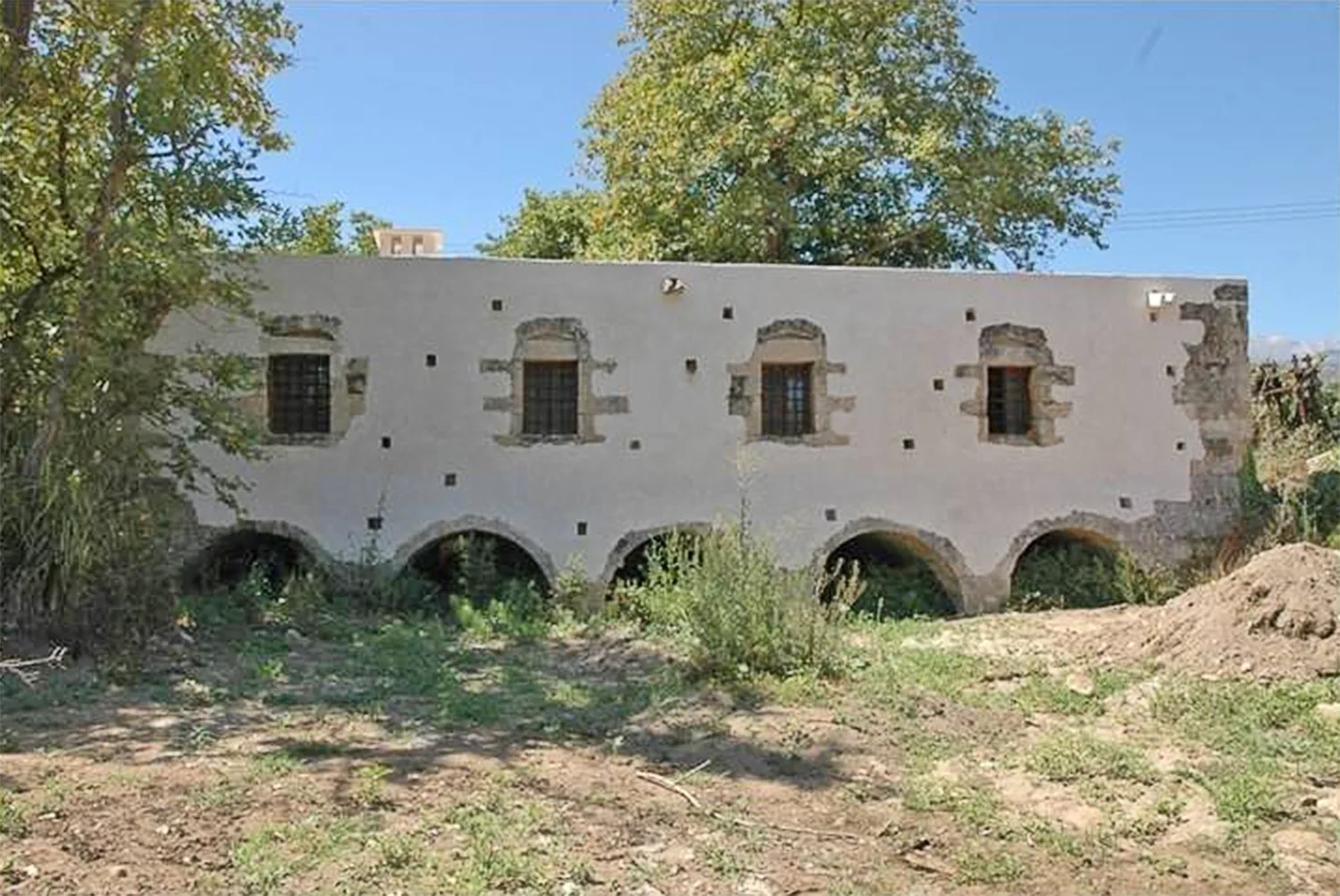
- Watermill of Kalogeroi, Stylos. (source: Marianna Aggelaki).
 Watermill of Kalogeroi in Stylos in the Route of Sustainability
-
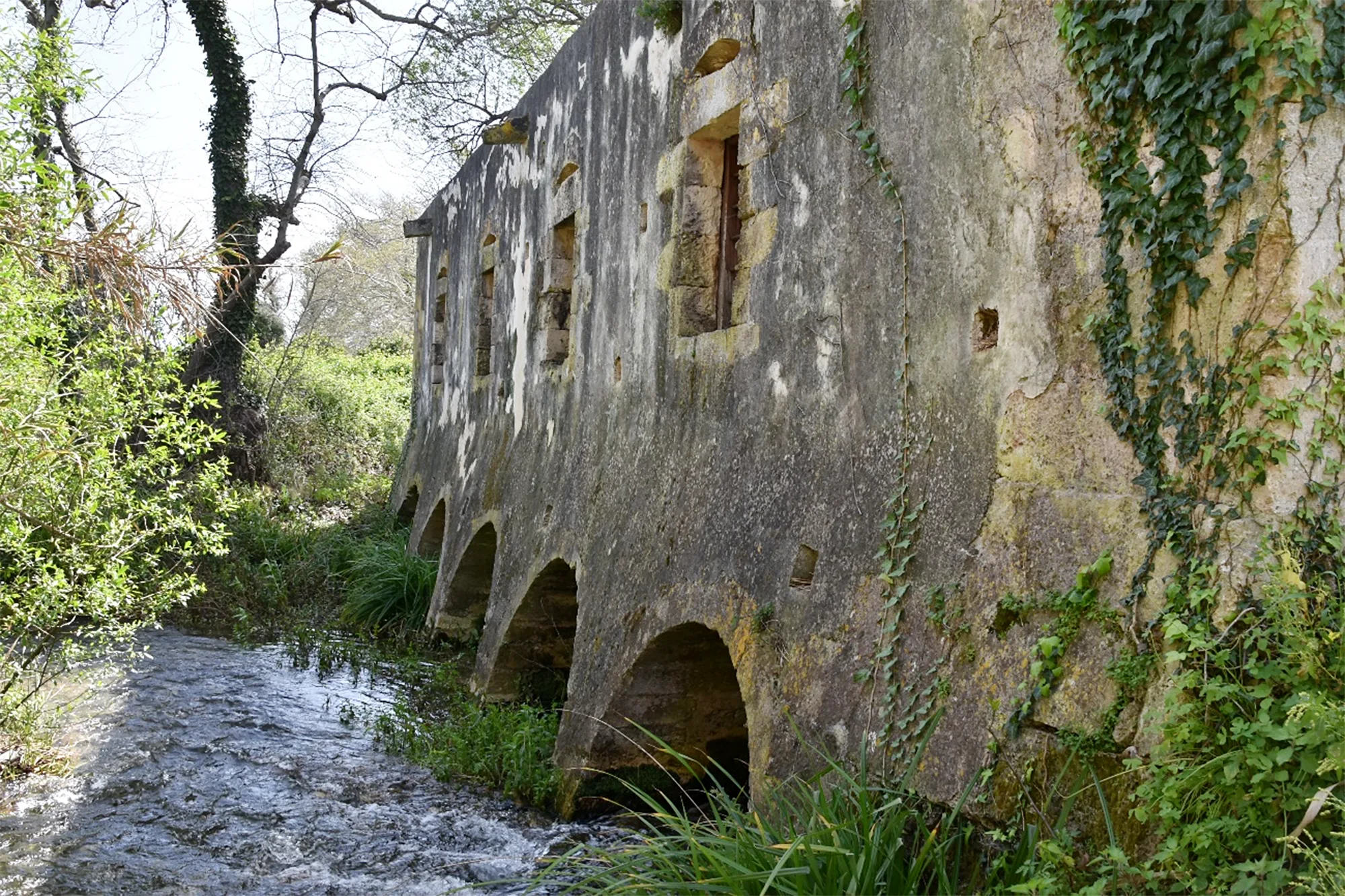
- Watermill of Kalogeroi, Stylos. The relationship between the building and the energy source is visible (source: Marianna Aggelaki).
 Watermill of Kalogeroi in Stylos in the Route of Rural Life
Owned by the powerful Monastery of St John the Divine of Patmos, the dependency of Stylos served as a granary from as the Middle Byzantine period onwards, when records show that large quantities of grain were sent to the monastery.
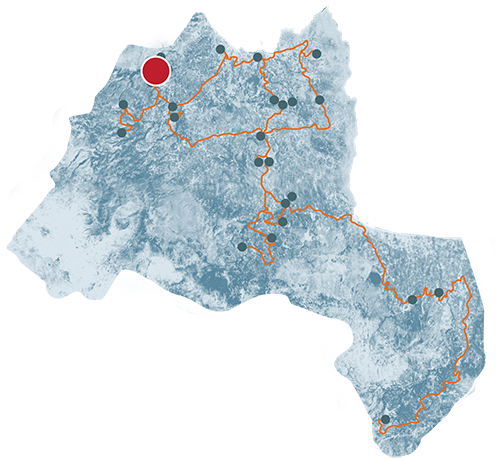
Stylos
Stylos is located at an altitude of 40 meters, on the banks of the river Koiliaris, and has abundant springs.
It is 18 kilometres from Chania.